


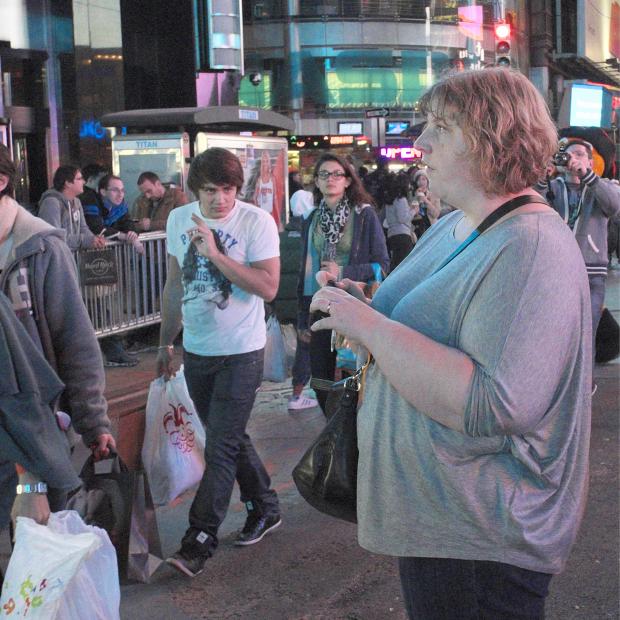

Haley Morris-Cafiero
–
Anonymity isn't for Everyone

Blondie

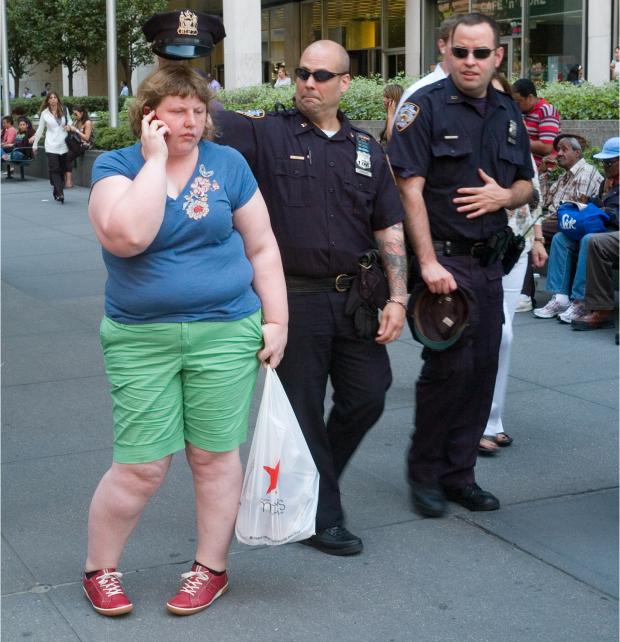
Cops..
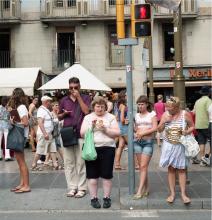
Gelato

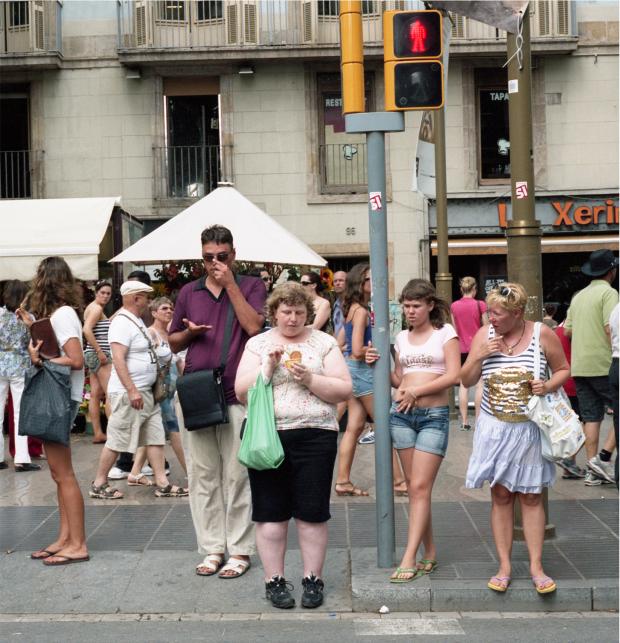
News Cafe
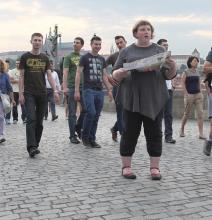
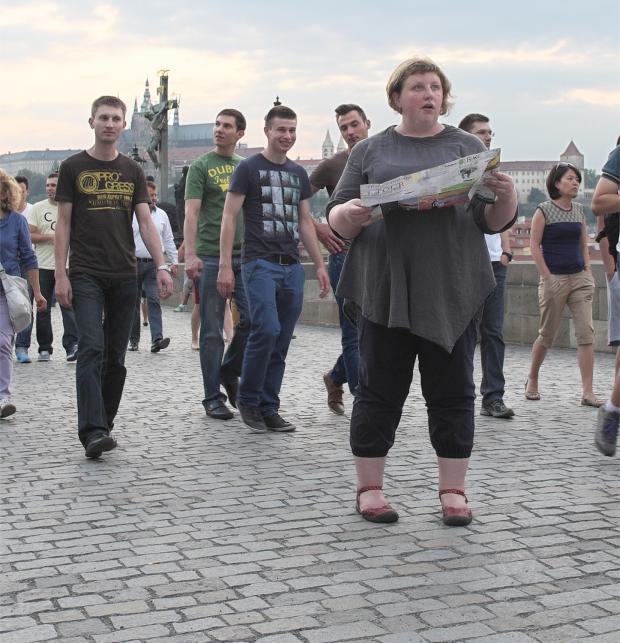
Progress
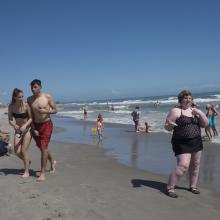
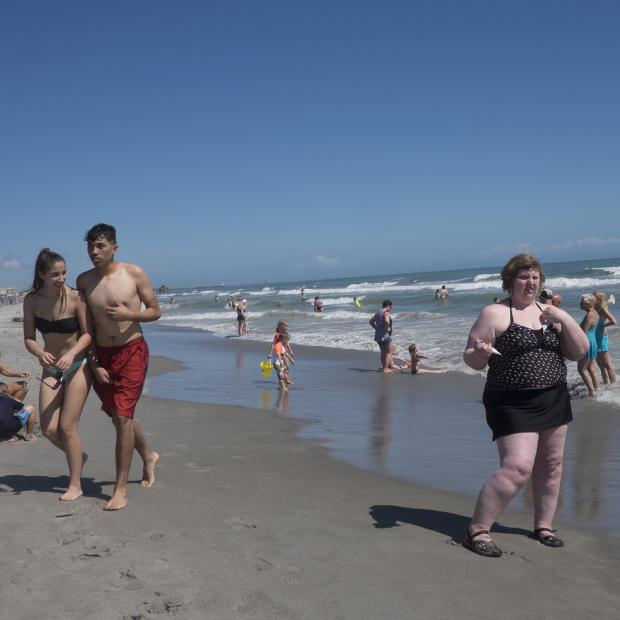
Sunscreen
Titan

Turtle
Part performer, part artist, part provocateur, artist Haley Morris-Cafiero (b. 1976) uses her photography as an activist voice to fight discrimination and social invisibility. Morris-Cafiero was born in Atlanta, USA, but is currently living and working in England.
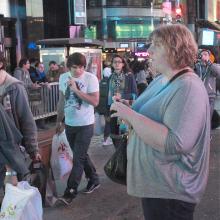
In her project Wait Watchers, first made public in 2013, Morris-Cafiero has been able to capture and reveal how body shaming in Western culture often manifests silently through the gaze. She explains how the idea to the project started when she took a self-portrait in Times Square, New York. After the film was developed, she noticed this man in the background looking at her. With her camera she had captured something so quickly and interesting, that it resulted in a social experiment for the next five years.
In the series Morris-Cafiero places herself in real-life settings doing normal activities, but it occurs within a culture where society has deemed thinness as the standard for the ideal body, resulting in the promotion of body shaming towards those belonging outside this category. In her own statement, Morris-Cafiero describes her project as follows:
“Wait Watchers is a series of photographs that document performances of my transgressing society’s rules that govern the female body and the gazes that are received as a result. My body is one that exists outside of the Western, Christian idealized female beauty standard and I use performances of mundane activities to position my body as a site for the public, unsolicited gaze. As I perform, I photograph the gazes of strangers as they pass by me. While I do not know what the stranger in the photographs are thinking or reacting to, their gaze could be considered critical or questioning of my actions in the frame.”
Even though Morris-Cafiero states that she does not know what the strangers in the photographs are thinking or reacting to, her work is usually exhibited with quotes directly taken from comments on her social media platforms or in real life:
“It’s disturbing to know people willingly look that repulsive.”
“If I looked like her, I would not be out in the daylight.”
“Fat lump of lard, stay of the donuts and go running.”
“It makes me ill, just looking at her.”
Exposing herself as a performer through her photography, Morris-Cafiero problematizes the Western societies ways of defining the ideal body, and more directly confronts how this binary construction fosters a culture of hate, hostility, and discrimination. With her project Wait Watchers Morris-Cafiero pushes back against the Western world’s unrealistic standards of beauty with her camera, by capturing the silent bullying inherent in the gaze.
ABOUT THE ARTIST
Morris-Cafiero’s works have been widely exhibited in solo and group exhibitions around the world, and have been featured in numerous newspapers, magazines and viral online including Le Monde, New York Times and Salon. Born in Atlanta, she is a graduate of the University of North Florida, where she earned a BA in Photography and a BFA in Ceramics in 1999. Nominated for the Prix Pictet in 2014 and the Deutsche Börse Photography Foundation Prize (longlist) in 2021 and a 2020 BMW Residency at the GOEBBLINS finalist, Morris-Cafiero holds a MFA from the University of Arizona in Art. The Magenta Foundation published her monograph, The Watchers, in 2015 and Fall Line Press published her second monograph, The Bully Pulpit, in 2019. Her work is included in the 2021 publication Photography – A Feminist History by Emma Lewis published by Tate. Morris-Cafiero is represented by TJ Boulting Gallery in London and is an Associate Professor and Subject Leader of Visual Arts at De Montfort University. She earned her practice based PhD from Westminster University in 2023.
For more information, please visit:
Website: https://www.haleymorriscafiero.com
Instagram: https://www.instagram.com/hmorriscafiero
Facebook: https://www.facebook.com/hmorriscafiero